
Reviewed · WALKING TOURS
Private Podgorica City Walking Tour
Podgorica rewards a closer look. I like the way this private walking tour links the modern center with the old Ottoman quarter, and I like that you can shape the conversation around your interests. The route also includes small, easily missed places such as Sastavci and the Vladimir Vysotsky monument.
The main consideration is simple: Podgorica is a small capital, not a city packed with grand sights. Some stops are brief, and Sastavci and the old fortress ruins are not well cared for. Still, a good guide can make the city’s mixed past much easier to understand.
Guides such as Ana, Petar, and Slavko have earned praise for their warm approach and practical advice. Ana has even added a rakija tasting along the way, while Petar has offered help with local matters in both English and French. That kind of personal contact is a major part of the tour’s appeal.
In This Review
- Key things to know before you book
- Starting at Independence Square in central Podgorica
- From Marko Miljanov to the National Theatre
- Crossing the Moraca River at Millennium Bridge
- Two bridges, one river, and a Russian poet
- Sastavci and the rough edges of Podgorica
- Entering Stara Varos and the Starodoganjska Mosque
- The Clock Tower beside socialist-era Podgorica
- Pushkin, Goncharova, and the return to the square
- What the private format adds
- Timing, comfort, and who should book
- Should you book the Podgorica walking tour?
- FAQ
- Where does the Podgorica walking tour start?
- Where does the tour finish?
- How long does the tour last?
- Is this a private tour?
- What language is the tour offered in?
- What should I bring?
- Are the stops included in the price?
- Can I cancel for a full refund?
Key things to know before you book
- A compact route with several sides of Podgorica: You move from Independence Square through modern streets, river crossings, Ottoman-era sights, and old neighborhoods.
- A true private experience: Only your group takes part, so you can ask questions freely and adjust the pace.
- The guide adds the value: The monuments themselves are modest, but clear stories about Montenegro’s past give them meaning.
- A good first walk: The tour helps you get your bearings before choosing restaurants, museums, or other places to visit.
- Allow up to two hours: The advertised duration is about 90 minutes to two hours, depending on pace and conversation.
- Come prepared for sun: Comfortable shoes, water, sunscreen, sunglasses, and a hat matter in summer.
Starting at Independence Square in central Podgorica
The walk begins at the fountain on Independence Square, also called Trg Nezavisnosti. The square was formerly known as the Square of the Republic, so you may hear both names during your visit.
This is a sensible meeting point. It sits in the center of Podgorica and is near public transportation. If rain is falling, the guide waits by Podgoricka Bank, under the eaves around the square. That small instruction matters, since a large open square can be an awkward place to search for someone in bad weather.
The meeting point is at 2 Novaka Miloševa. A guide holding a sign has made the start easy to find, and confirmation is provided when you book. I recommend arriving a few minutes early, especially if you want to begin with questions about the city or ask the guide to adjust the route.
Independence Square is also a useful introduction to Podgorica’s modern identity. It is not a grand European plaza lined with centuries-old buildings. Instead, it helps show the city’s newer urban character before the walk moves toward older streets and monuments.
More Walking Tours in Podgorica:
- Private north Montenegro tour -Moraca River Canyon and walk trough Virgin Forest
★ 5.0 · 1 review - Sunset walking in NP Skadar lake from Podgorica
★ 5.0 · 1 review - Kotor Old Town Walking Tour
★ 5.0 · 357 reviews
From Marko Miljanov to the National Theatre
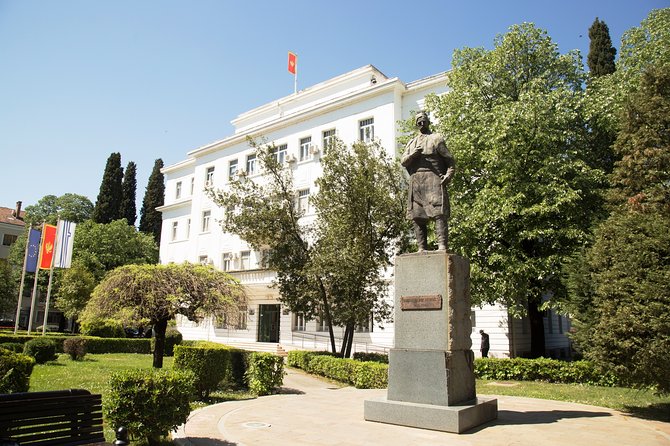
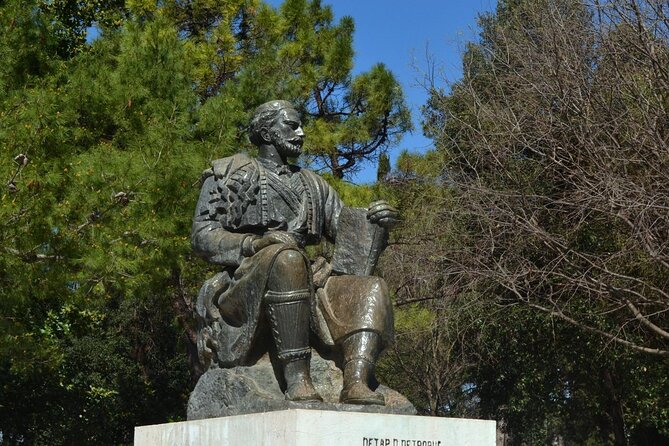
The first section heads toward the monument to Marko Miljanov and Bokeska Street. You then stop at the Montenegrin National Theatre before reaching the statue of Petar II Petrovic Njegos in the park opposite.
These figures give your guide a chance to explain Montenegro through its writers, rulers, philosophers, and military leaders. Njegos is especially important to the country’s cultural story. He was a prince-bishop, writer, and philosopher, so his statue is more than a decorative stop in a park.
This part of the route is useful because it shows how Podgorica presents national identity in public spaces. You are not simply checking off monuments. You are learning why certain people are remembered and how the country links literature, religion, leadership, and independence.
The scheduled stop is about 15 minutes, though a private walk gives you room to ask for more detail. If you enjoy politics, poetry, or Balkan history, tell your guide early. The route can be adapted to suit your interests, and this is the point where a private format starts to pay off.
Crossing the Moraca River at Millennium Bridge
The route continues across one of the bridges over the Moraca River, Podgorica’s main waterway. You see the Millennium Bridge, one of the city’s best-known landmarks.
The bridge provides a change of pace. After central streets and statues, you get an open view along the river and a clearer sense of how Podgorica is arranged. It is also a natural photo stop, so keep your camera ready rather than packed away.
The planned visit lasts about 15 minutes. That is enough time to hear why the bridge matters to the city and take photographs without turning the stop into a long pause. The walk remains active, but it is not a race. You set the pace with your guide.
I would not book this tour expecting dramatic mountain views from every corner or a long list of major monuments. The appeal here is the connection between ordinary city spaces, river crossings, and the stories attached to them.
Two bridges, one river, and a Russian poet
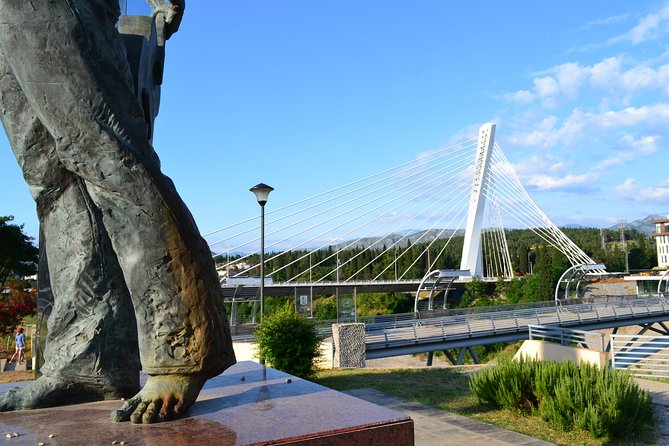
After the Millennium Bridge, the walk passes the monument to Vladimir Vysotsky. The Russian poet, singer, and songwriter lived in Podgorica for a time, giving the city an unexpected link to Russian cultural life.
The stop is short, about five minutes. That is enough for an explanation and a photograph. It is also the sort of detail you might miss without a guide. Podgorica’s history is not presented in one tidy chapter, and this monument adds another layer to the city’s story.
You then cross the Moraca again at Blazo Jovanovic Bridge. The second crossing helps you see the river from another angle and leads toward Sastavci, where the Ribnica and Moraca meet.
This section works best if you enjoy small details. The bridges and monuments are not grand attractions in the usual sightseeing sense. Their value comes from the way your guide ties them to Podgorica’s past and present.
More city tours in Podgorica:
- Private transfers from Podgorica Airport and city to Budva
★ 5.0 · 41 reviews - Podgorica Car Trip – Architecture, History, Wine tasting, Churches, Doclea city
★ 5.0 · 20 reviews - Skadar Lake & Virpazar return trip from Podgorica city
★ 5.0 · 17 reviews - Private transfer from Airport Podgorica and city to Kotor
★ 5.0 · 8 reviews
Sastavci and the rough edges of Podgorica
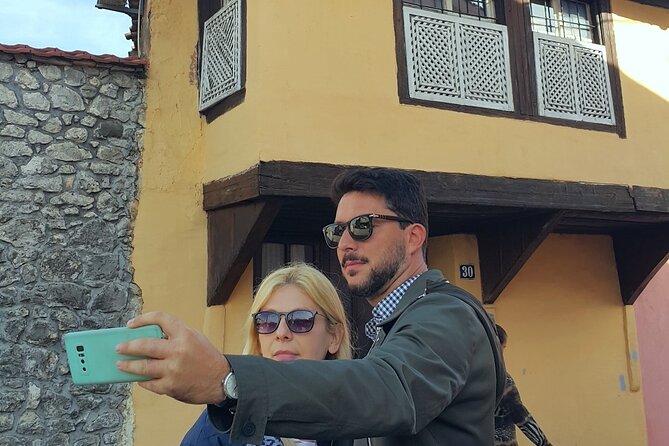
Sastavci, also called Skaline, is one of the more picturesque points on the walk. It is the meeting place of the Ribnica and Moraca rivers, with the remains of the Ribnica fortress above it.
The site is not well maintained. The ruins are barely visible, and the area may feel neglected compared with the polished center. That is worth knowing before you arrive. You will not find a restored fortress with formal exhibits or an elaborate entrance.
Yet this is one of the most interesting stops because it reveals the older foundations of the city. The ruins are known as Nemanjin grad, linked with Stefan Nemanja, who later founded the Nemanjic dynasty. A guide can help you understand why an unimpressive-looking ruin still matters.
You cross an old stone bridge on the way to Stara Varos, the oldest preserved quarter of Podgorica. The bridge and the river junction provide some of the route’s most atmospheric moments, even if the setting is somewhat uncared for.
I appreciate that the tour does not pretend every historic site is perfectly restored. That honesty gives you a better sense of the real city. Podgorica has been shaped by change, conflict, rebuilding, and modern development. Its rough patches are part of the story.
Entering Stara Varos and the Starodoganjska Mosque
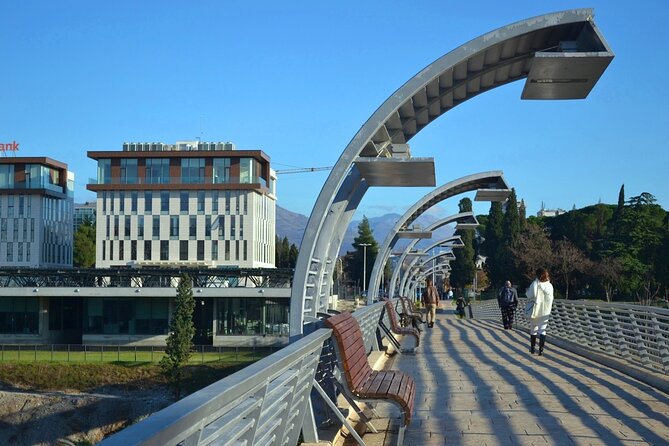
Stara Varos dates from the period of Ottoman rule and remains the oldest preserved quarter of Podgorica. The streets here feel different from the central square and newer apartment areas, which makes the transition especially useful for understanding the city.
The walk pauses at the Starodoganjska Mosque, built in the 15th century. For many years, traders from nearby shops maintained it. That detail gives the building a strong link to everyday commercial life, rather than treating it as an isolated religious monument.
The stop lasts around ten minutes. It is a short visit, so you should not expect a full interior tour or an extended architectural study. The value lies in the setting and in the chance to see a surviving reminder of Podgorica’s Ottoman period.
Your guide can also help place the mosque within the wider mix of influences found in Montenegro. The tour moves between Orthodox, Ottoman, socialist, and modern references without requiring you to visit a museum. For a first look at the capital, that variety is useful.
The Clock Tower beside socialist-era Podgorica
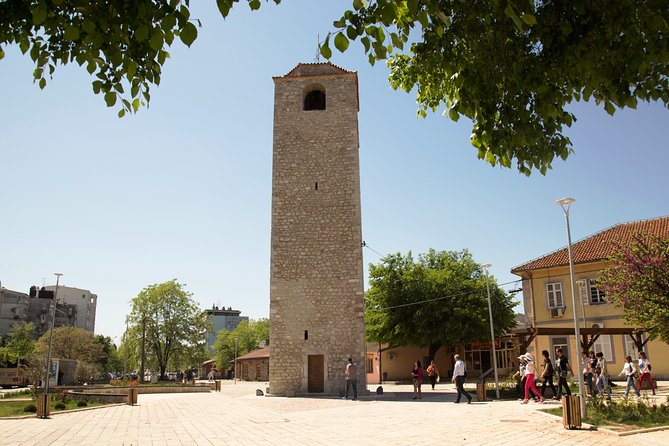
Sahat Kula, the Clock Tower, marks the edge of Stara Varos. Built in the 18th century by Adzi Pasha Osmanagic, it is one of Podgorica’s key landmarks.
The tower faces socialist apartment blocks across the street. That contrast is one of the most telling views on the walk. In a single stop, you can see an Ottoman-era structure beside the urban form of a later political period.
The tour allows about ten minutes here. That gives you time for photos and an explanation of the tower’s place in the city. It also gives you a chance to ask how Podgorica changed as it became the modern capital of Montenegro.
This is a good example of why a guide helps in Podgorica. The Clock Tower is easy to photograph, but its real interest comes from the layers around it. You see an old landmark, a newer city, and the space between them.
Pushkin, Goncharova, and the return to the square
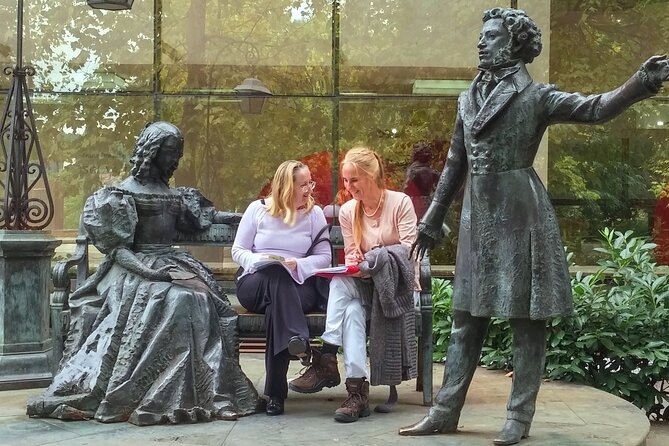
The final stop is a monument to Alexander Pushkin and Natalija Goncharova on the corner of Njegoseva Street. It shows Pushkin reading poetry to his wife.
The stop lasts about five minutes and is mainly for photographs and a final cultural detail. Like the Vysotsky monument, it highlights Podgorica’s connection with Russian literature and art. It is an unusual way to end a city walk, and it prevents the route from becoming a standard parade of political statues.
From there, you return to Independence Square. The circular route is convenient if you have onward plans in the center. You can ask your guide for recommendations at the end, which is especially useful if this is your first afternoon in Podgorica.
Ana has provided restaurant suggestions and nearby ideas after the walk, and one guide ended the outing at the local restaurant Lanterna, where local dishes were available. That kind of practical help can be worth as much as another monument, particularly in a compact capital where you may have limited time.
What the private format adds
The price is $45.15 per person. For a private walk lasting about 90 minutes to two hours, I consider that fair if you value conversation and flexibility. You are paying less for admission tickets, since all scheduled stops are free, and more for the guide’s time, local context, route planning, and answers to your questions.
A group discount is available, which can improve the value if you are traveling with family or friends. Because only your group participates, you do not need to match the pace of strangers or wait while a large crowd gathers around a monument.
The private setup also helps with interests. You can ask for more attention to Ottoman Podgorica, national figures, local food, architecture, or practical city advice. The advertised route gives you a strong base, but the conversation is where the walk can become personal.
Guides have received praise for being friendly, clear, and generous with practical information. Ana is noted for her lively approach and willingness to answer many questions. Petar has guided in both English and French, and Slavko has been described as easy to talk with and good company. Guide quality always matters on a walking tour, and these names give you useful expectations about the people who may lead it.
Timing, comfort, and who should book
The walk is offered in English. Most people can take part, and service animals are allowed. Since the route crosses bridges and moves through several parts of the city on foot, comfortable shoes are the sensible choice.
Summer heat deserves attention. Bring water, sunscreen, sunglasses, and a hat. A camera is also recommended, especially for Millennium Bridge, the river junction, the stone bridge, the Clock Tower, and the Pushkin monument.
The tour requires good weather. If poor weather forces a cancellation, you are offered another date or a full refund. You can cancel for a full refund up to 24 hours before the start time, but changes or cancellations inside that 24-hour window are not accepted.
I would recommend this walk to first-time visitors, cruise passengers with a short window, couples, families, and anyone who wants a gentle introduction before exploring alone. It is also a good fit if you prefer asking questions to listening to a fixed speech.
You may want something else if you are seeking major museum collections, grand palaces, or a packed schedule of landmark interiors. The tour is a city orientation with local stories, not a full-day cultural program.
Should you book the Podgorica walking tour?
Book it if you want Podgorica explained rather than simply photographed. The route brings together Independence Square, the National Theatre, Njegos, two river bridges, Sastavci, Stara Varos, the Starodoganjska Mosque, the Clock Tower, and two Russian cultural monuments.
I especially like it for a first day in the capital. You will see the city’s newer center, Ottoman quarter, river setting, and less polished historic corners in one manageable walk. The main weakness is the modest scale of the sights, but a good guide turns that limitation into an honest and useful introduction.
At $45.15 per person, the private format makes the most sense for a small group that will ask questions and use the guide’s restaurant and sightseeing advice. If that sounds like your style, this is a worthwhile way to get your bearings in Podgorica.
FAQ
Where does the Podgorica walking tour start?
It starts at the fountain in Independence Square, also called Trg Nezavisnosti, at 2 Novaka Miloševa in Podgorica.
Where does the tour finish?
The walk ends back at the meeting point in Independence Square.
How long does the tour last?
The approximate duration is between one hour and 30 minutes and two hours.
Is this a private tour?
Yes. Only your group participates in the activity.
What language is the tour offered in?
The tour is offered in English. One guide, Petar, has also guided in French and English.
What should I bring?
Comfortable shoes and a camera are recommended. In summer, bring sunscreen, sunglasses, a hat, and a bottle of water.
Are the stops included in the price?
All listed stops have free admission. The price is $45.15 per person.
Can I cancel for a full refund?
Yes. You can cancel at least 24 hours before the local start time for a full refund. Cancellations or changes made less than 24 hours before the start time are not accepted.
Just added in Podgorica
- Private Wine Tasting Activity at Lipovac Winery★ 5.0 · 11 reviews
- Wine tour- Family winery visit, food tasting & Skadar Lake boat cruise★ 5.0 · 4 reviews
- Transfer from Podgorica to Sarajevo★ 5.0 · 2 reviews
- Transfer Podgorica city center- Podgorica Airport★ 5.0 · 1 review
- Podgorica Unveiled: A Cultural Journey★ 5.0 · 1 review
- Transfer Podgorica Airport-city center★ 5.0 · 4 reviews
- NORTH TOUR Np Biograd Gora-Lake-Moraca Canyon & Monastery-Kolasin★ 5.0 · 3 reviews
- ALBANIA tour – Rozafa, Skadar lake, Niagara waterfalls, Shkodra★ 4.0 · 10 reviews
Walking Tours, compared.
Private Kotor Walking Tour – Rick Steves Recommended
Read our review →
Great tour of coastal monasteries in Budva – Walking on the path of history!
Read our review →
Food, wine and the best private walking tour of Kotor
Read our review →
Browse the lists this tour appears in